

Research and insights
Three charts that reveal the inequalities in temporary accommodation
Published date: 11 December 2025

William Matthews
Research Officer
Our latest three interactive charts illustrate who is most affected by homelessness and temporary accommodation.
Originally intended only for emergencies, temporary accommodation has become a longer-term reality for an extraordinary number of people in England. Today, over 84,000 families ─ including more than 172,000 children ─ are in temporary accommodation. Too often, this means living in overcrowded and mouldy conditions that damage health, isolate people from family and friends, and undermine children’s education and wellbeing.
At Shelter, through our services we help people in temporary accommodation find better, more appropriate homes. We believe that no child should grow up in temporary accommodation, but because there are so few social homes, we continue to see the numbers increasing.
To help change this, we’ve documented the sheer scale of homelessness (including temporary accommodation), and how this varies across the country. We’ve also produced a report on the huge impact that temporary accommodation has on children and their families.
Unfortunately, this is not the full story. Government data also reveals stark inequalities in who is stuck in damaging temporary accommodation ─ and who stays there the longest. The insurance company esure, one of our corporate partners, has funded work to analyse and visualise this government data to show who is most affected. Here, we look at three charts that reveal these inequalities.
Black-led households and temporary accommodation
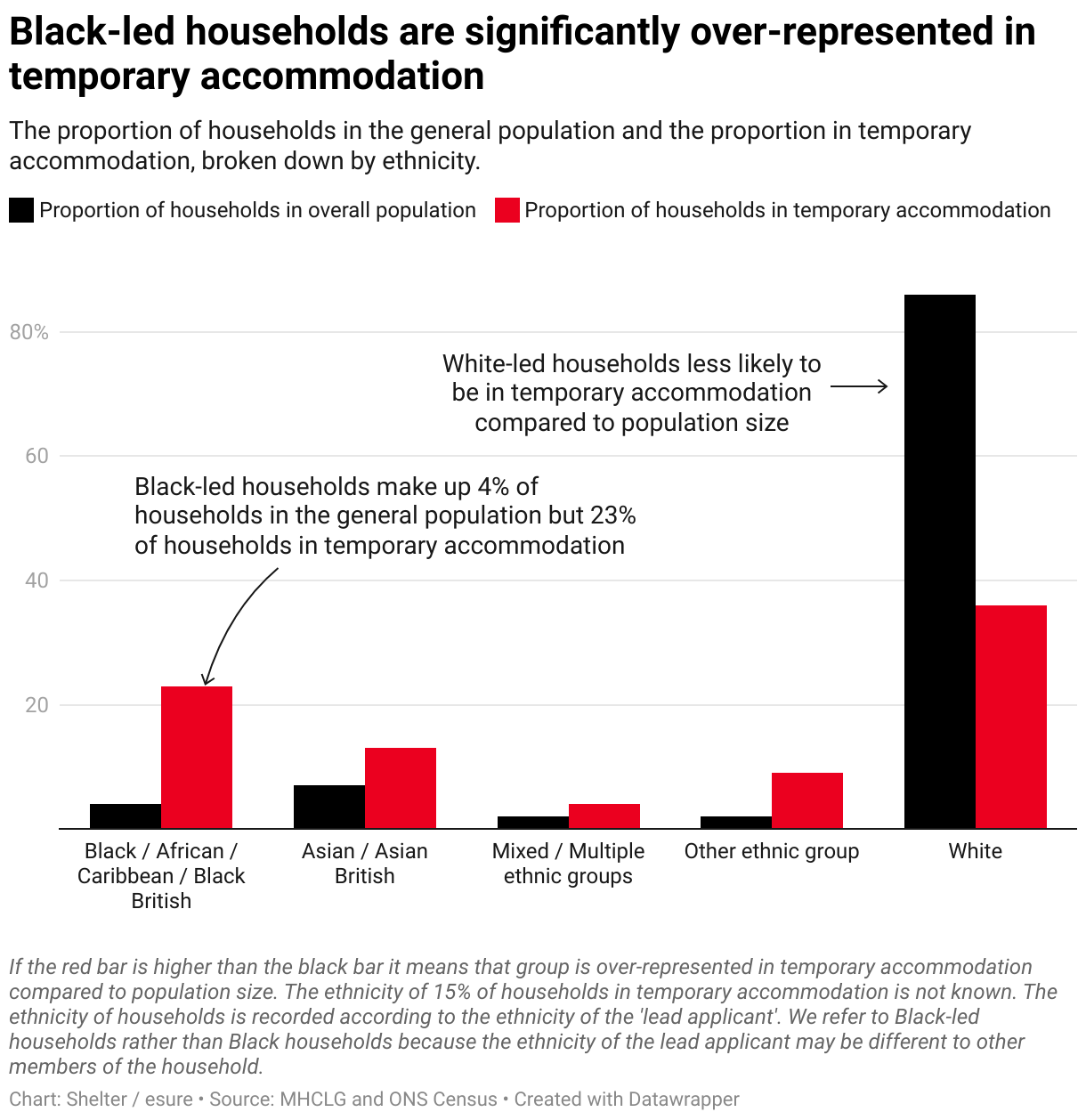
Black-led households are significantly more likely to be homeless in temporary accommodation compared to other groups. They make up just 4% of the general population but a huge 23% of households in temporary accommodation. We refer to ‘Black-led’ households because the ethnicity of a household in temporary accommodation is recorded according to the ethnicity of the person making the homeless application. This may differ from the ethnicity of other household members. Asian-led households, mixed-led households, and households led by those in other ethnic groups are also over-represented in temporary accommodation, although not to quite the same extent as Black-led households.
In contrast, White-led households make up 86% of households in the general population but only 36% of households in temporary accommodation. This means Black-led households are 13 times more likely to be in temporary accommodation than White-led households.
When we say a group is over-represented, we mean that they live in temporary accommodation more often than you would expect based on how large that group is in the general population. If groups weren’t under-represented or over-represented, then the proportions of people in temporary accommodation would roughly match the proportions in the population. When they don’t match – when a group shows up more than their ‘fair share’ – we describe that group as over-represented. In other words, it means that group is more likely to experience temporary accommodation than other groups.
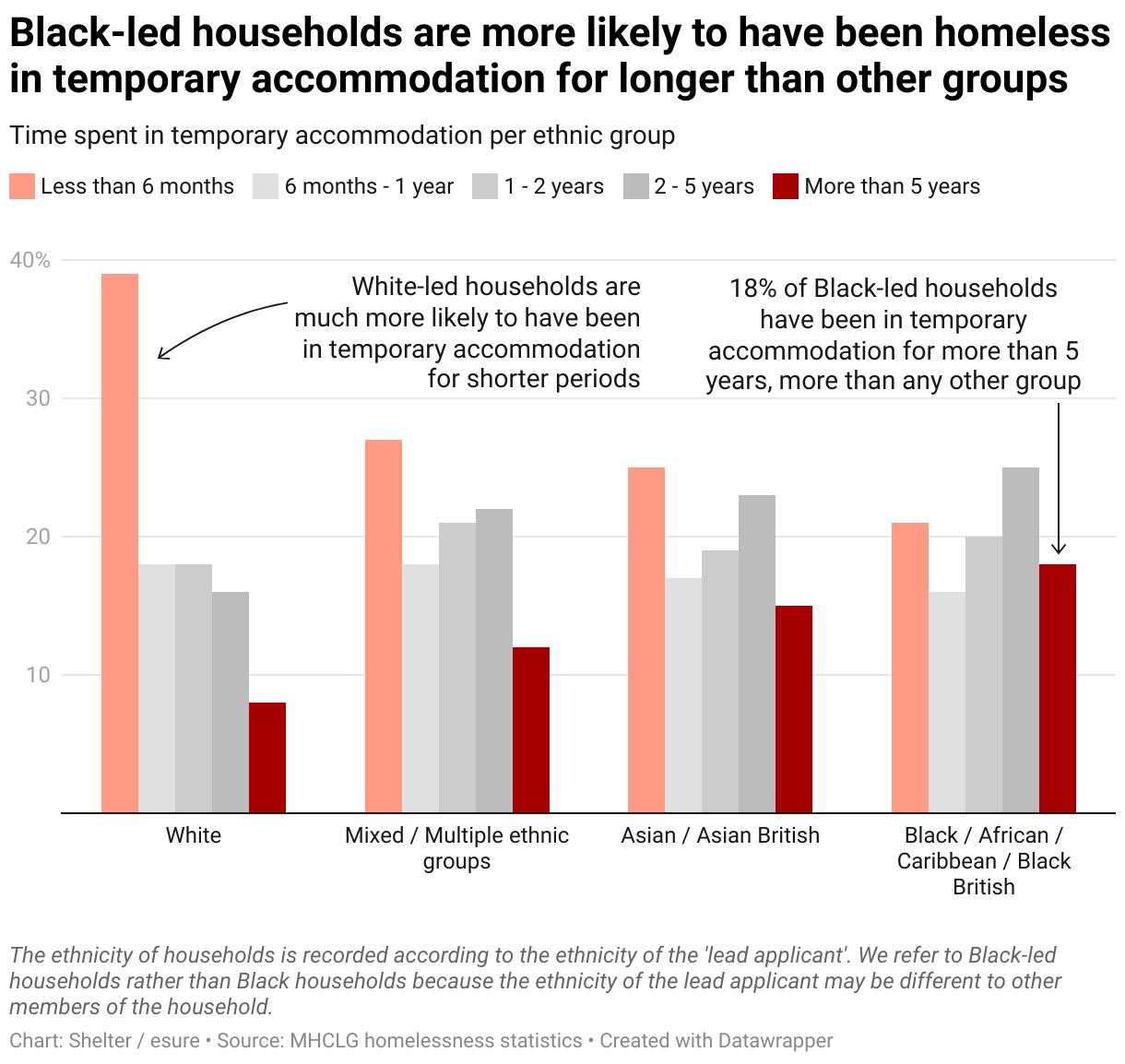
Not only are Black-led households more likely to be in temporary accommodation in the first place, they are also more likely to stay there for longer. Eighteen per cent of Black-led households are in temporary accommodation for more than five years, compared to only 8% of White-led households. This makes longer, more damaging stays more than twice as likely for Black-led households. In contrast, White-led households are far more likely to have been in temporary accommodation for less than six months.
Longer stays make the negative effects of temporary accommodation worse, and the impact of this is devastating ─ particularly for children. More than 1 in 3 children don’t have a bed of their own in temporary accommodation, and nearly half have to move school as a result of becoming homeless. Three-quarters of households experience poor conditions, and two-thirds of people report temporary accommodation as having a negative impact on their mental health.
But why are Black-led households so much more likely to be in temporary accommodation, and to stay there longer than White-led households? A severe shortage of social rent homes across the whole country, particularly in London, is a key systemic factor.
Black people are also more likely to face discrimination in the private rented sector, which makes housing insecurity worse and homelessness more likely. On top of this, since Black-led households are more likely to claim local housing allowance (LHA), they are also more affected by the current freeze on LHA rates. This means many can’t afford increasingly expensive private rents, freezing them out of the private rented market. The freeze on LHA makes it much harder for households to move on from temporary accommodation into a settled home.
New research from Heriot Watt University also shows that Black families facing homelessness are less than half as likely as White families in similar circumstances to get access to social housing in England. Our new research into Black and Black Mixed heritage people’s experiences of accessing social homes in England identified evidence of racism, stereotyping, excessive questioning, and suspected de-prioritisation. This is mirrored in new research with Black and Black Mixed Heritage households in temporary accommodation. Overall, this creates a double disadvantage: Black-led households are more likely to become homeless, and then are less likely to access social housing once they are homeless.
Lone mothers and temporary accommodation
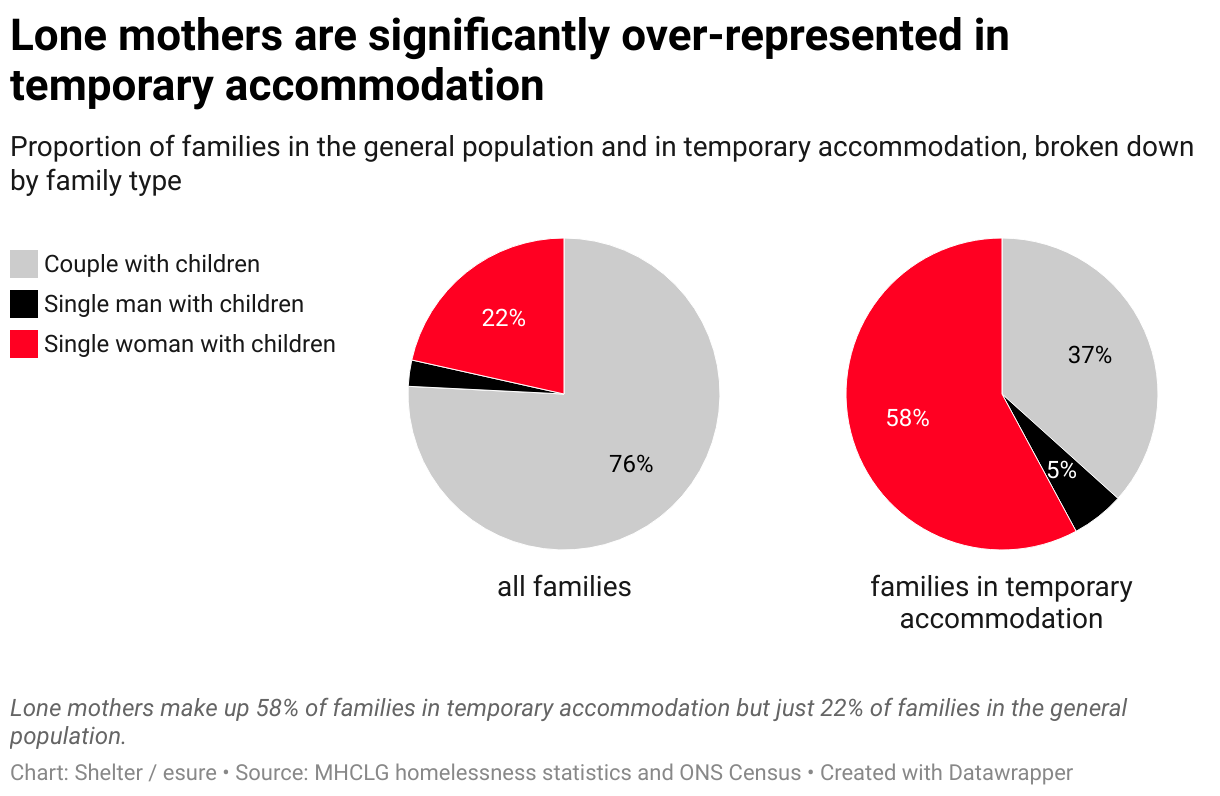
Lone women with children are also hugely over-represented in temporary accommodation. They make up 22% of families in the general population, but an enormous 58% of families in temporary accommodation. There are now over 43,000 lone mothers in temporary accommodation.
Lone-mother households are more likely to be homeless because they have only one income. This means it is difficult for them to compete against couples and sharers for a family home in the expensive private rental market. The need to juggle childcare and work often means their income is further reduced. Lone parents can also face discrimination from landlords, making it even harder to find a secure home.
What should the government do?
The only way to end homelessness for good is through investment in social rent homes. A decent social home provides a foundation that gives children the best start in life, as council housing did for previous generations. It’s forward-thinking, fair, and essential to transforming our society. And because Black-led households and lone mothers are most affected by homelessness, they stand to benefit the most from more social homes being built.
The government’s £39bn spending review investment in social and affordable homes is a game-changer. We now need the government to set a target for how many social rent homes will be delivered this parliament and ramp up to 90,000 a year for 10 years.
However, it takes time to build social rent homes, and the record number of children stuck in damaging temporary accommodation can’t wait that long. That’s why, in the short term, the government must immediately unfreeze LHA rates so that they cover at least the bottom third of local rents. This will mean that families in temporary accommodation will be able to afford a safe and decent private rented home in the meantime.
No family should face homelessness alone this Christmas. Donate today and you could help a family get the support they need, when they need it most.