

Racism in our housing system
Racism can be obvious or harder to recognise, but one thing we know is that it is widespread in the housing system.
Why the fight for home is a fight against racism
We believe that everybody should have the right to access and live in a safe, secure home. But evidence shows that this isn’t a reality for everyone.
The housing emergency affects people across the whole of society, but we know that People of Colour – particularly Black communities – are hit hardest.
They are disproportionately more likely to be made homeless, live in deprived neighbourhoods and poor-quality homes. This is because of historical inequities, modern policies and systemic racism.
Racism impacts people in every part of the housing system
The housing system includes the laws, policies, organisations, and economic factors that shape how homes are built, let, managed and regulated.
At every stage of navigating this system – whether dealing with unaffordable rents, unsafe conditions, overcrowding, lack of rights, or discriminatory treatment from housing professionals (such as landlords and local authority housing staff) – racism can affect people’s experiences and outcomes.
Homelessness
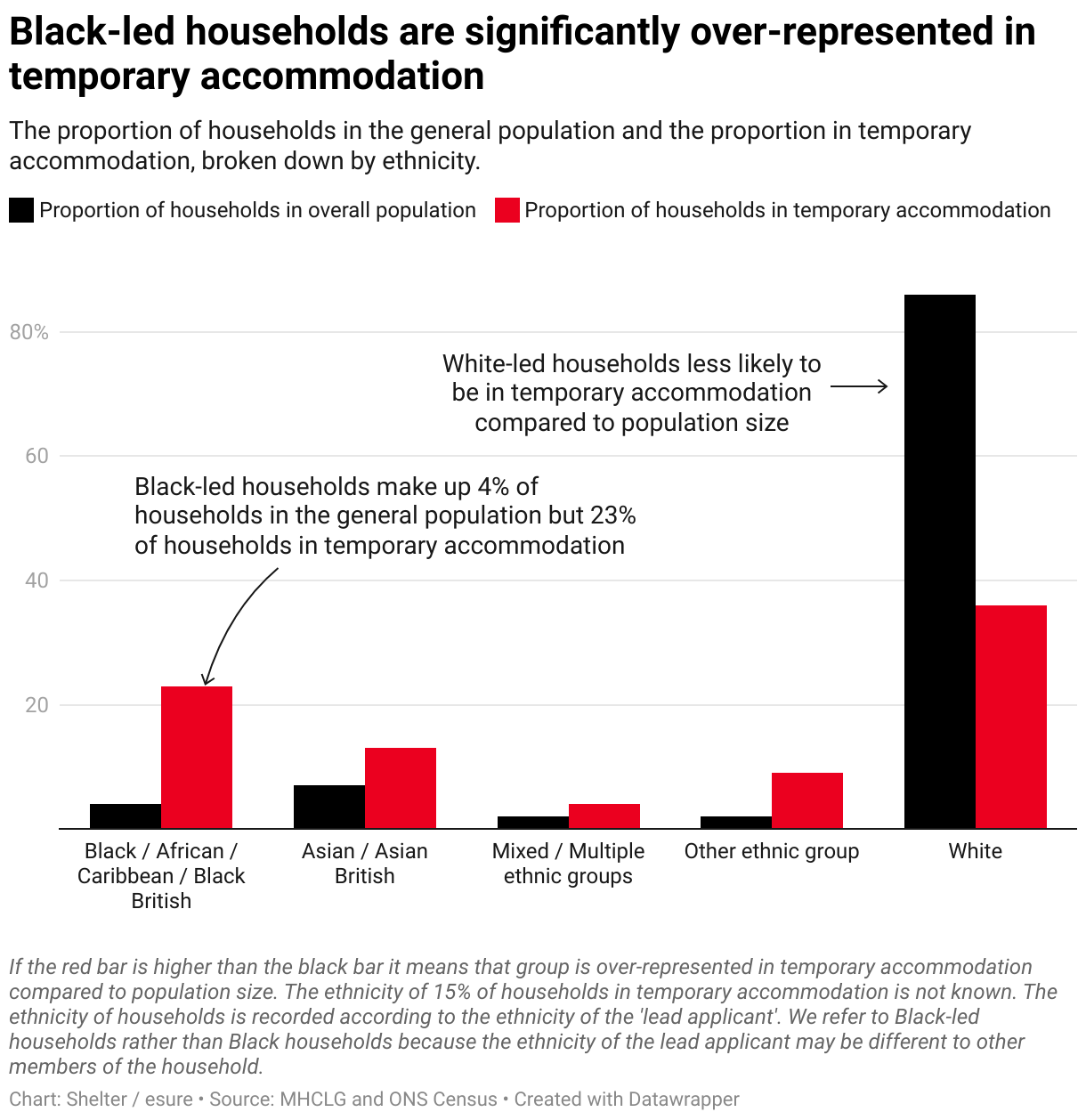
Black-led households face the highest rates of homelessness. They are almost 13 times more likely¹ to be stuck in temporary accommodation than White-led households.
Disrepair and poor conditions
Among renters, People of Colour are 51% more likely to have put up with poor conditions (such as leaks or pests) to be able to rent their home.²
They are also 22% more likely to have experienced damp or mould in the last year compared to White British/Irish renters.²
Direct discrimination
Among renters, People of Colour are 87% more likely to have experienced illegal acts³ by their landlord in the last year compared to White British/Irish renters.²
One third (32%) of Black people with experience of homelessness reported discrimination from a social or private landlord.
Problems affording a home
People of Colour are more likely than White people to face persistently low incomes after housing costs. Bangladeshi and Black families are most likely to need housing benefit to help cover the cost of housing.
The shortage of genuinely affordable homes increases the risk of overcrowding – which is highest among Arab, Bangladeshi, Black African, and Mixed White and Black African households.

'I felt like I was being pushed to the back of the queue [for housing support]. It was a very bad experience and I couldn't help but wonder if my "race" was playing a role in how my application was being handled.'
- Interviewee

Structural racism and historical policies that have made racism systemic
Historical legal and policy decisions, like the ones listed below, have disadvantaged People of Colour and migrants in particular. Research shows the negative impact this had, and continues to have, on People of Colour’s access to a safe and secure home.
Post-war period (1940s–1960s): racial steering and restrictive allocation rules
From the mid-20th century, racial steering by social housing providers meant that People of Colour were routinely placed away from White communities and into less desirable, under-resourced areas.
At the same time, restrictive allocation policies emerged. Local residence requirements, introduced between the 1940s and 1960s, meant that applicants had to live in an area for a set period before qualifying for a social home there. These rules particularly affected newly arrived migrants from former colonies, who were increasingly differentiated according to their country of origin, immigration status, and associated rights.
1970s–1990s: ongoing racial discrimination in access to housing
Through the 1970s, discriminatory practices continued to affect migrants and People of Colour. Many faced racist treatment from letting agents when trying to access good-quality rented homes and, as a result, were more likely to end up in poor-quality accommodation and vulnerable to exploitation by ‘slum’ landlords, such as the notorious Peter Rachman.
Through the 1980s and 1990s, several investigations also uncovered that some local authorities used racist allocation practices, including offering People of Colour poorer-quality properties or making it harder for them to be rehoused.
1980s onwards:
Immigration controls and exclusion from housing registers
Immigration status became increasingly linked to the right to access public funds. By the 1990s, it became a statutory requirement to exclude people seeking asylum and those subject to immigration controls from social housing registers, further limiting access for many People of Colour.
The Right to Buy era
Meanwhile, the introduction of the Right to Buy policy in the 1980s reduced the social housing stock without sufficient replacement. People of Colour were also less likely than White households to have the income needed to purchase their own homes, leaving them more affected by the shrinking supply of social housing.
Community responses and positive developments
In response to systemic exclusion, Black and Minority Ethnic (BME) housing associations emerged to challenge mainstream discrimination. Some continue today, though others have struggled to remain financially viable.
This legacy of historic policies continues to impact Black and Black Mixed heritage households today as they navigate a housing system that has long been shaped by exclusionary practices.
Modern policy decisions that affect all renters, but particularly disadvantage People of Colour
Lack of social homes
Decades of underinvestment mean not enough social homes are being built. This has a larger impact on People of Colour, particularly Black communities, because they are more likely to be homeless than White-led households, or living in unsafe or unaffordable homes.Inadequate housing benefit
As some Communities of Colour are more likely to need housing benefit to help cover the cost of housing, inadequate housing benefit impacts them more.Lack of renters’ rights
People of Colour are more likely to privately rent their home than those in White British-led households, leaving them affected by inadequate protections against discrimination and unfair rent hikes.
Modern policies designed to create a hostile environment for migrants create additional barriers for all People of Colour trying to access a safe and decent home.
Right to Rent
Right to Rent rules require landlords to check prospective renters’ immigration status before agreeing to a tenancy. If a landlord is found to be letting to someone without the right to rent, they could face a fine of up to £20,000 or five years in prison.
This means that some People of Colour struggle to access a home, even if they are British-born or have the legal right to rent. Research has found that the policy pushes landlords towards declining any prospective tenant without a UK passport, encouraging racist assumptions about migration status.
No recourse to public funds
Thousands of people, including families, have immigration conditions that give them no recourse to public funds, meaning they can’t access housing benefit, or receive homelessness assistance from the council.
We know that a safe home is essential for a decent life, yet this policy leaves people – including families – vulnerable to poverty, overcrowded housing, exploitation and, in the worst cases, homelessness and destitution.
Racism cuts deep, and the pain can last generations
Our ground-breaking report My colour speaks before me³ documents people’s experiences of racism at many levels. It explores direct racism by individuals, such as housing officers, and also looks at the discriminatory policies and wider systems that allow racism to become embedded and reproduced.
Black and Black Mixed heritage participants reported unequal treatment, racial stereotyping, culturally insensitive communication, and a lack of appropriate training among housing officers.
In this video, housing campaigner Kwajo Tweneboa sat down with two of the peer researchers involved in shaping the report, Uche and Victoria, to discuss the extra barriers Black people face when trying to access a social home.
Video transcript
Today, I'm here with Uche and Victoria to discuss a new campaign by Shelter which they have helped co-produce.
I wanted to start by asking you both why you felt it was important for you to be a part of this campaign and what it meant to you.
[Victoria] The opportunity to do this campaign came and then I thought, okay, this would be good. So, you know, I got an opportunity to be like the voice of the voiceless.
[Uche] It’s really important to highlight that the system is broken and needs to be changed.
[Victoria] So I wanted to talk to you both about the concept of slippery discrimination.
So the racism was not in my face. It was hidden, like, swept under the carpet. But I just knew that this was what it is. But I just couldn't pinpoint that.
[Uche] I mean, for me, the slippery discrimination was more a case of gatekeeping. You walk into the council hub, you need your support. They tell you everything you need to bring in. If you need your supporting letters from your GP. You bring in everything, because you're not going to just go there because you don't know how long you're going to spend there.
So you go there with everything that you need and then yes, they turn around and say, well, unfortunately we won't be able to help you today because of this or because of that.
And then you're like, okay, so what do I need to do?
They know what you need to do for you to fix that whatever it is that's missing that they need, but they won't signpost you to where you’re supposed to go to get it. So they know what you need, and they're just basically hiding that information from you and making it harder for you.
You're about to be homeless, you're homeless.
You know, there's a situation at hand and the people that have the power to help you are not helping you.
So you start to question yourself.
What’s wrong with me?
Why won’t you help me?
Whereas when you look around and you see, you know, certain people of different colours and they’re getting all the help that they need. And you can hear them speaking to them differently as well. The tone changes, the attitude changes.
You can feel the discrimination.
You can feel the racism.
You can see it from the way that they look at you, the tone of their voice. That was my experience, for me. It's just the undertones of it, the undercurrents, like the gatekeeping of it.
[Kwajo] I think with my own, and I've spoken about this before in terms of slippery discrimination and what my Dad faced, and witnessing that as a child and our family situation with homelessness. It was very obvious, especially in regards to local authorities and their interaction with him, even as a child, that there was elements of racism and discrimination.
And importantly, there I also thought there was a huge level of classism being shown towards him because of his background. And we saw it with interactions.
I mean, my Dad, when he was phoning up having to try and change or shift his thick African, or Ghanaian, accent.
Exactly, code switching. And you were stuck on a waiting list for 15 years, right?
[Uche] So for me, it was a negative impact already because the first thing they do is tell you, you might have a long wait on the list.
It's not just going to be... so already they're taking the hope, you know, because all I want is a home for myself and my kids. So already you've put a barrier in front of there. You're depressing me already.
There were things that they could have told me to do or places they could have signposted me to. That will give me further advantage, but they just kept quiet. Hence the gatekeeping that I was talking about.
[Victoria] Well, for me, I waited for 14 months.
I couldn't think about my future.
All of that was in my head was: I need a place to stay.
I cannot just be on the streets.
So it had, you know, an adverse effect on my mental health.
[Kwajo] So there's a long history here when it comes to racism and discrimination in relation to housing. And part of the report, a key part of the report, is intergenerational racism and trauma. How has it affected communities like yours?
[Uche] On my part, what I'd say is a lot of families have been affected by this.
It's not just — I've got some friends that are from the West Indies, from the Caribbean.
They talk a lot about their parents, their grandparents and the housing situation at the time.
You know, when they first came to live in the UK, came to Britain.
And, you know, they talk about the trauma that they experienced as a family and how that's trickled down to them and their kids presently because you talk about things like, you were called over here to help out. And then once you get here, you start being mistreated, you start being looked down upon. You start being treated unfairly because of the color of your skin.
I think from that respect, just that respect at least — from the human side of it — I think it's important to remind ourselves that what happens in the past also affects the present and the future.
So now I'm thinking, well, what about my kids?
You know, this happened to my grandparents.
It's happening to me.
I think changes should be made now so that we don't suffer or our children don't suffer what we have suffered.
[Victoria] I think this could actually go back to slippery discrimination.
I've spoken to quite a lot of black people or mixed heritage people.
And one of the first things they tell me is when we first came here, older people actually, the racism was quite in your face.
Someone could tell you, “I don't like you because you're black,” and just leave it at that.
But because now it's like, you know, they can't tell you to your face.
So they've got to be very subtle about it.
[Kwajo] And I mean, Victoria, what I wanted to ask you is what would you say to people both inside the social housing world, or the housing sector, but also outside the sector, who may think or say:
“Well, this isn't an issue that's affected me. So therefore it doesn't matter. I don't need to deal with it.”
[Victoria]
Okay. I've heard a lot of people say “I don't see colour,” but I'm going to need you to start seeing colour. Because when you see colour, then you can understand the pain the next person is going through.
You can understand how privileged you are, and you can understand why something needs to be done about this situation.
[Kwajo] And I mean, part of the changes that we’re seeing in government is to do with qualifications and training for those working within the sector.
And one of the recommendations, off of the back of this report, is training specifically around this anti-racism, anti-discrimination.
And off of the back of the conversation we've had, do you feel like this is a must?
It needs to happen if we're really going to create the change that we want to see for future generations?
[Uche] I would have to agree there, because, I mean, at the end of the day, the Competence and Conduct Standard — why can't racism and discrimination be part of that?
Because that is obviously part of the wider problem that we are facing here.
Because if that is not included in that, then you're not really pushing much, if you know, so to speak.
Especially considering what's going on, the current climate of things that are happening currently within the UK and around the world. I mean, discrimination and racism plays a major part of that.
You know, people need to be trained.
You have to use the qualifications on your certificate and come and help people.
And you should be held accountable to that.
[Victoria] They need to be empathic towards other people's experiences.
The slippery discrimination, the intergenerational... it’s all linked in together.
[Kwajo] I wanted to ask: what is one thing you'd like someone watching this to take away as a message from the campaign?
[Victoria] First of all, acknowledging there are people that are going through harder obstacles towards accessing a social home.
[Kwajo] And what we need to see off the back of this is action. We need to see policy changes, but not just lip service. We also need to see action because that's what really matters off of the back of this.
[Victoria and Uche] Absolutely.
[Kwajo] Thank you both.
[Uche] Thank you Kwajo, thank you.
Change is possible
In July 2025, we launched our first anti-racism housing campaign. Since then, thousands of supporters have joined our call for a social housing system that promotes fairness and inclusion for everyone.
And, in July 2026, we scored a major victory: the Regulator of Social Housing confirmed that anti-racism would be a key part of the new Competence and Conduct Standard for social landlords.
This sends a clear message that social housing providers must prioritise the fair treatment of tenants, staff must be professionally qualified with anti-racism as part of this, and they must be held to account to this new standard.
We will continue to fight for a housing system free from racism and discrimination.

Recent articles on racism in housing
Shelter campaigners win!
Shelter campaigners calling for racism to be tackled in social housing have had a positive response from the Regulator of Social Housing…Read on
Tackling racism must be a priority in social housing
Last year, we launched ground-breaking research on racism in access to a social home...Read on
Don't give up: Tracy's story
This is our house, our family home for 52 years. When my son was taken, my faith, my family, my Jamaican half and my heart made it to him…Read on
We're committed to being an anti-racist organisation
As leaders in the housing and homelessness sector, we cannot allow the legacy of systemic racism to be one of rising homelessness, unfit and unsafe housing. So the fight against racism is fundamental to our purpose of defending the right to a safe home.
Explore our commitmentsResources
Evidence on this page
'More likely to be homeless’ means some groups of people are more likely to experience homelessness when compared to their percentage of the overall population. For example, Black-led households make up 4% of households in the general population, but 23% of households in temporary accommodation. This means Black-led households are overrepresented in temporary accommodation. Source: Statutory homelessness in England: April to June 2025 - GOV.UK
Shelter/YouGov survey of 4,023 private renting adults (18+) in England, 2023.
Private renters experiencing illegal acts has been defined as those who said they have experienced at least one of the following:
my landlord/letting agent cut off my electricity/gas/water for no good reason. My landlord/letting agent has entered my home without giving any notice/a chance for me to give permission. My landlord/letting agent has stolen or damaged my personal belongings or possessions. I have paid a tenancy/damage deposit to a landlord or agent and they have not placed the deposit with any of the approved government protection schemes. I have been removed from a private rented home without being given the proper notice period and/or without the correct procedures being followed by the private landlord/letting agent. I have experienced threatening behaviour, harassment or assault by my private landlord or letting agent. Essential safety or household appliances/amenities were not working when I moved into a property (e.g. broken fire or smoke alarm, water or central heating not working). I have been treated unfairly by a landlord/letting agent due to my race/age/nationality/gender/sexual orientation/disability.
Words on this page
People of Colour (or PoC)
This is a term used to refer to anyone who does not identify as White.
Structural racism
A system in which public policies, institutional practices and cultural representations reinforce ways to perpetuate racial inequity. It includes dimensions of history and culture that have allowed privileges associated with ‘Whiteness’ and disadvantages associated with ‘People of Colour’ to endure and adapt over time.
Structural racism is not something that a few people or institutions choose to practice. Instead, it has been and still is a feature of the social, economic and political systems in which we all exist.
Systemic racism
This refers to the way racism is built into every level of our society. One difference between the terms is that structural racism analysis pays more attention to the historical, cultural and social psychological aspects of our currently racialised society. Systemic racism refers to the way racism is built right into every level of our society.
Anti-racism
This is the proactive dismantling of systemic racism and racist policies underpinning the White privileged society in which we exist. It addresses the specific harm and impact of racism on all racially marginalised communities and proposes equality of outcome, not just opportunity.
For Shelter, this means recognising how race directly impacts the experience and outcomes of our staff and clients, whether positively or negatively, and acknowledging the role power plays, who has it and how it's used.
Share this page
The more people that our information reaches, the greater our chance of creating real social change. Can you share this with friends or family?