

Foundation to Thrive report: how to unlock a council housing revolution
England is in the grip of a housing emergency. This report sets out the bold action required to get councils building again.
Getting councils building again is the key to ending the housing emergency
England is in the grip of a housing emergency. Decades of failing to to build enough genuinely affordable social homes has led to record numbers of homeless households in temporary accommodation.
To end the housing emergency, we need to build 90,000 social rent homes a year, for 10 years.
Local authorities must be at the heart of responding to this challenge.
There is significant need for genuinely affordable social homes for local people, with over 1.3 million households on social housing waiting lists in England.¹
Building social housing reduces pressure on other local authority services, including the cost of temporary accommodation, which has soared to £2.9bn a year.²
Building can boost productivity and economic activity, sustain local small and medium enterprise builders and protect jobs in construction.
However, last year councils delivered just 3,800 social rent homes. This is the highest figure since the early 1990s³, but nowhere near the numbers needed.

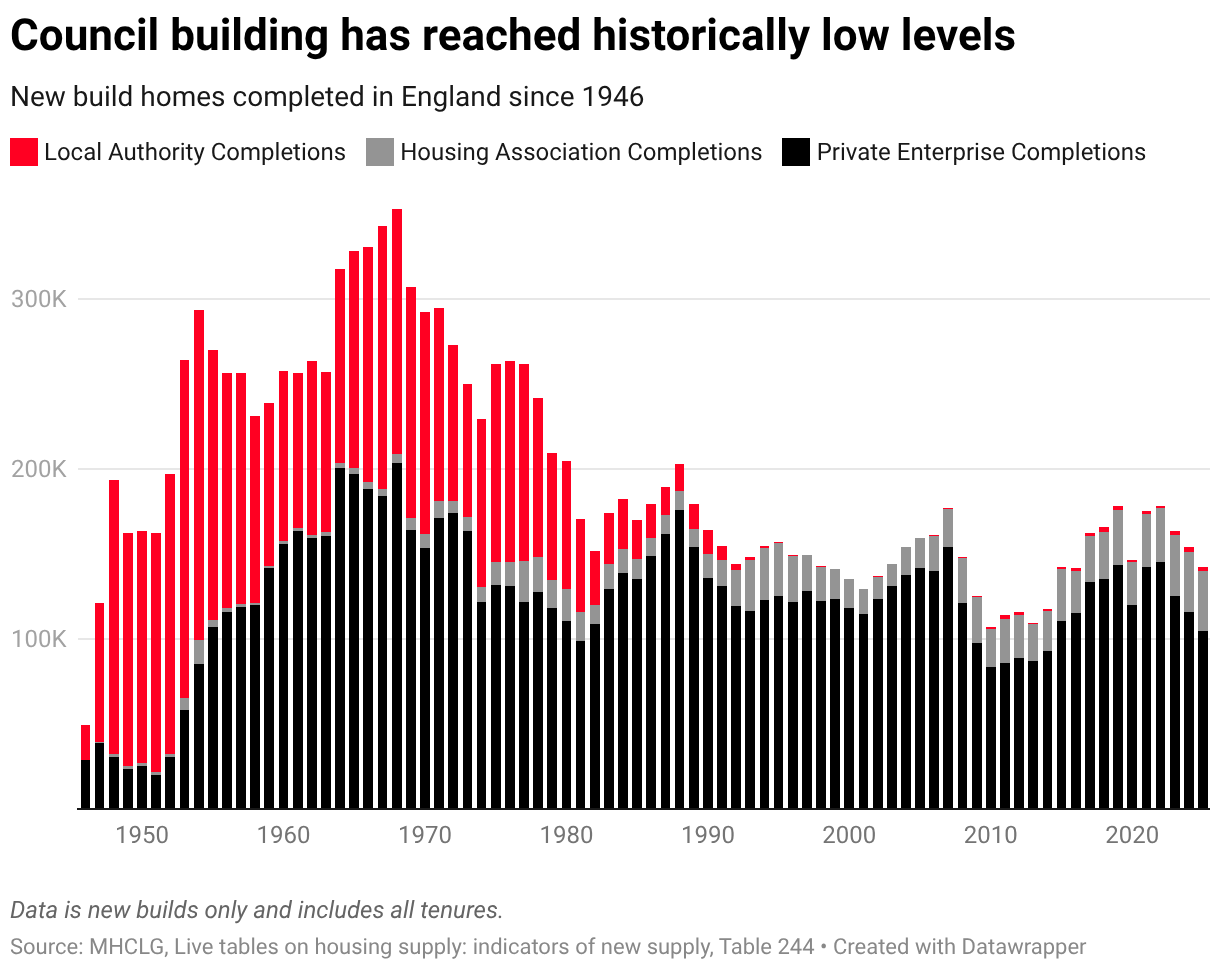
This isn't good enough. We need to rebuild the capacity and culture of housing delivery in local government. We need to get councils building again at scale.
Our new report sets out how to achieve this goal – by dismantling the in-built bias against council housing with interventions in finance, land and delivery.
Full report: Foundation to Thrive - How to Unlock a Council Housing Revolution (PDF) (13.1MB)
Executive summary: Foundation to Thrive - How to Unlock a Council Housing Revolution (PDF) (7.8 MB)

The recommendations
Shelter proposes a package of measures to empower councils to once again take a bold, active role in building and managing new social homes.
Cancel the Housing Revenue Account debt owed to the Treasury
This debt is stopping councils from building social homes.
Councils spend on average 15% of their rental income on HRA debt interest, with some paying more than 100%.⁴ This money could instead be invested in building and maintaining new social rent homes.
The government should cancel all £31.8bn of HRA debt. This would unlock capacity for councils to build over 280,000 social rent homes⁵, generating a net benefit of £141.5 billion to the economy over 60 years.⁴
Crucially, cancelling the debt would have a limited immediate impact on the government’s fiscal rules, as it is money the public sector owes to itself.
What is Housing Revenue Account debt?
Every council that manages a substantial number of social homes holds a Housing Revenue Account (HRA). This is funded by tenants’ rents and ring-fenced from the council’s general budget.
When the 2012 HRA self-financing settlement was introduced, councils took on a fixed level of HRA debt, in exchange for greater agency and financial independence. This settlement was supposed to increase management and maintenance allowances, raising expectations that councils would once again be able to build at scale to meet local housing need.⁴
But since then, successive governments have undermined the assumptions in the agreement, for example by increasing Right to Buy discounts, making the debt unsustainable.
Rethink fiscal rules and ramp up investment
HRA debt cancellation will provide the capacity to build council homes, but it will take additional government investment to build them at scale.
Consecutive governments' economic policy has discouraged public-led delivery of social homes for decades. To tackle the housing emergency, the government must drive a change in economic consensus and start treating the loans and grants required to build social housing as an investment rather than a financial burden.
Social housing should be seen as a safe investment. In fact, it makes more financial sense to build than not. The cost of not scaling up delivery to 90,000 social rent homes a year over a decade is quantified in Cebr’s Cost of Inaction report: £64.4 billion in direct costs to the government, alongside £52.4 billion in lost economic benefits, within the first 10 years alone.⁶
The government should bring forward planned spending earmarked for later stages of the Social and Affordable Homes Programme (SAHP) and concentrate it on social rent.
The overall grant in the SAHP should also be increased, to further ramp up investment towards building 90,000 social rent homes a year.
To deliver this, the government would need to change either its fiscal rules around investment or the way it measures debt; both are ambitious asks.
As an interim measure, we propose the government excludes HRA and public corporations from its current measure of debt. This would allow government to loan councils money for building on the same low interest rates they currently only offer to housing associations.
Looking for a longer explainer of how the government can unlock social housing investment by changing their fiscal rules? Read our article on the topic: How to increase investment in council housing and capitalise on the economic benefits
Establish a national council housing mission
Every day, councils see the financial and human impact of homelessness and bad housing. Across local authorities, there is a real willingness to get building again.
But decades of market-led housing policy have drained the expertise and political will that supported the post-war social housing boom.
To address this, the government should:
continue to build councils’ in-house resources and capacity for delivery, particularly within planning teams
introduce a national target for social rent homes
institute a new delivery compact with local authorities to return to largescale council housebuilding in return for HRA debt removal
appoint a council housing champion within the Office of the Prime Minister and Cabinet, responsible for coordinating priorities between central and local government.
Additionally, government must align planning policy with local housing need by:
setting a national minimum requirement of 20% social rent homes on all medium and large developments
amending the standard method for assessing local housing need so that it considers the number of households experiencing or at risk of homelessness
supporting councils to recruit and retain more planning staff.
Prioritise land for council housing
Since the post-war boom in council housebuilding, the value of land has sharply increased. The financial gains have largely flowed to private interests, with public land increasingly used to generate short-term revenues for the state. Since 1980, 1.6 million hectares of public land have been transferred from the public to the private sector, often for a fraction of its potential value.⁷
The General Disposal Consent 2003 continues to encourage councils to prioritise short-term sale receipts over public policy goals.
The government should replace this outdated policy with an ‘optimal use duty’, requiring public landowners to maximise social and economic value from their land, including high levels of social rent housing.
Beyond public land, government should support councils and development corporations to acquire and assemble private land at a fair price.
Land value and property taxation should be reformed to discourage speculative land holding and empty home ownership.
Acquire homes to deliver social housing quickly
There are over 300,000 long-term empty homes in England – a 49% increase over the last decade.⁸
Councils should be empowered to convert neglected homes in private ownership into good-quality, affordable social homes.
Acquisitions are a relatively rapid, green and cost-effective way for councils to grow their social housing stock, particularly for councils who have not managed or built homes in decades.
To ensure acquisitions are targeted to improve the whole housing system and deliver as many social rent homes as possible, local action must be supported by a policy direction from central government.
The government should:
set out an ambition in the forthcoming housing strategy to reduce the number of low-income households in expensive and poor quality private rented homes
launch a dedicated national acquisitions programme with its own funding and guidance for councils to acquire empty and neglected private rented sector homes
scrap VAT on renovating empty homes for social rent.

It’s time to unlock a council housing revolution
The government has the power to end the housing emergency.
By taking the bold action needed, they can enable councils to build tens of thousands of social homes a year once again – an essential step towards the 90,000 social homes the country desperately needs.
Read the full reportFootnotes
1. MHCLG, Live tables on rents, lettings and tenancies, Table 600, accessed September 2026.
2. MHCLG, Local authority revenue expenditure and financing England: 2025 to 2026 individual local authority data - outturn, Table RO4, accessed September 2026
3. MHCLG, Live tables on affordable housing supply, Affordable housing supply open data, accessed August 2026.
4. Pragmatix Advisory, Funding the future: the financial and economic case for cancelling Housing Revenue Account debt, Shelter, August 2026.
5. Savills, Options for reducing Housing Revenue Account debt, Shelter, July 2026.
6. Cebr, The cost of inaction, Shelter, September 2025.
7. B. Christophers, Rentier Capitalism: Who Owns the Economy, and Who Pays for It?, Verso Books, 2022.
8. MHCLG, Live tables on dwelling stock (including vacants), Table 615, accessed September 2026.

Let’s get councils building again
Sign our letter to the Chancellor ahead of the budget on the 28 October
More that may interest you

Let's build social housing

