

Research and insights
International Women's Day 2026: we must all #GiveToGain the social homes we need
Published date: 6 March 2026

Deborah Garvie
Policy Manager
On Sunday 8 March, we'll celebrate International Women’s Day (IWD). Worldwide, we’ll recognise the social, economic, cultural and political achievements of women. 2026 marks a milestone 115 years of IWD’s collective action, advocacy and fighting for gender equity. Each generation has built on the courage of those before it, pushing boundaries and redefining what’s possible.
This year’s theme is #GiveToGain. Because when we give, we gain. Giving is not a subtraction; it's intentional multiplication. There’s power in reciprocity and support. When people, organisations and communities give generously, opportunities and support for women increase. And when women thrive, we all rise!
The housing emergency in England disproportionately affects women, leaving them without the foundation to thrive and reach their potential.
Women are sleeping rough
Last week’s government statistics revealed a shameful record high of 4,793 people estimated to be sleeping rough in England last autumn, a rise of 3% in a year. While women make up only 15% of people sleeping rough, there’s been a disproportionate rise in women sleeping rough – up 8%, compared to 2% for men.
It’s possible this is due to better recording of women sleeping rough. Lots of amazing women have been involved in the Women’s Rough Sleeping Census, which aims to collect more comprehensive data on women experiencing rough sleeping and trial a different method of data collection. Shelter’s Community Hubs, such as Shelter North East and Shelter Bristol’s Women’s Action Group, supported the Women’s Rough Sleeping Census.
However, it’s likely women remain under-recorded in official statistics because they don’t meet the government definition of rough sleeping: people about to bed down (sitting on/in or standing next to their bedding) or actually bedded down in open air (on the streets, in tents, doorways, parks, bus shelters or encampments) or in buildings or other places not designed for habitation.
Bedding down is risky for anyone on the streets because they’re exposed to the elements and criminal activity. But for women, the added risk of sexual harassment or assault makes it even more dangerous. Black women, and other women of colour, face the further fear of racist harassment and assault. Instead, women report wandering the streets at night or sitting in public places to try to stay safe.
Women are stuck homeless in damaging temporary accommodation
Rough sleeping is only the visible tip of the homelessness iceberg. Hidden from view are a record number of households stuck homeless in damaging temporary accommodation. This is provided by the council to those who qualify, often because they have children or have survived domestic abuse.
Last week’s government statistics revealed further record highs in temporary accommodation. There are a record 134,760 households stuck in temporary accommodation. This includes 85,730 families, with 175,990 children and teenagers under 18 – roughly equivalent to the number of children in Leeds.
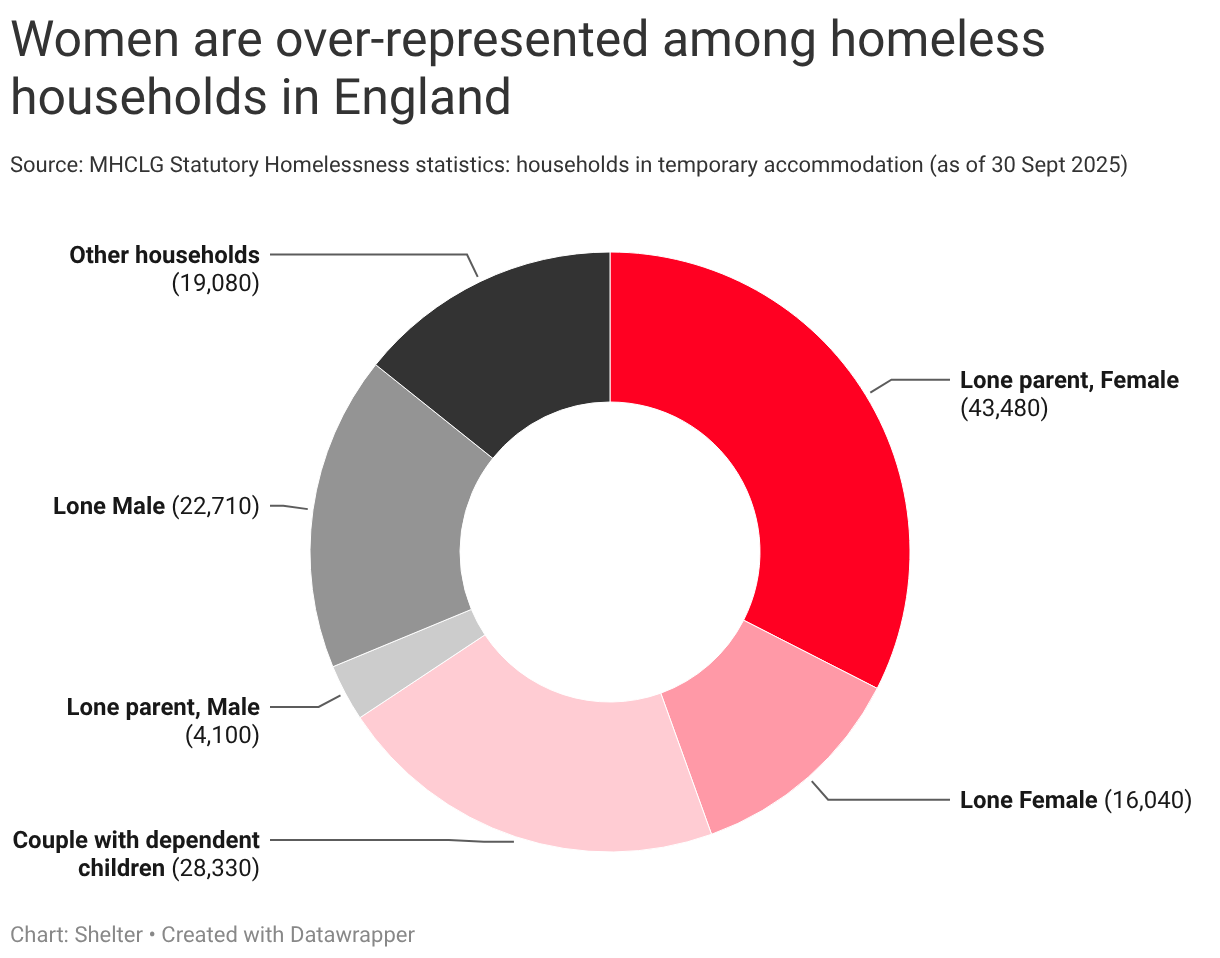
The majority (well over half) of these households contain women:
a third (33%) are lone mothers
over a fifth (21%) are couples with children, most of which are likely to include women
12% are lone women
Temporary accommodation is damaging because it’s so insecure, with frequent short-notice moves. Our biggest ever survey of 1,112 people living in temporary accommodation found:
three in ten (30%) of the households surveyed had lived in three or more temporary accommodation places. One person had moved fourteen times
two-thirds (62%) of people were given less than 48 hours’ notice when they were last moved between temporary accommodation placements
This insecurity can take its toll on mental health, triggering stress and anxiety:
two in three (66%) people reported that temporary accommodation had a negative impact on physical or mental health
seven in ten (71%) said that their stress or anxiety had worsened because of being in temporary accommodation
six in ten (61%) parents reported that temporary accommodation had a negative impact on their children’s stress or anxiety
‘I have been in temporary accommodation since 2004… They have not made me permanent. Still, 19 years [later]. My daughter is 21, we don’t know what will happen to us and I’m approaching 60 years. Living in temporary accommodation is depressing and makes me anxious… I still hope for permanent in the near future. I don’t know how long I have.’
- Survey respondent

For women with neurodivergent children, these impacts are compounded.
Women are giving their time and energy to end the housing emergency
Women are telling their stories of hidden homelessness in damaging temporary accommodation. And they are calling for the new generation of social homes our country desperately needs – to give them the foundation to thrive, and to end gender discrimination in housing for good. Women such as:
the three mothers who described life in temporary accommodation and the impact of finally moving to a permanent home
the peer researchers who described their stories of facing racism when trying to access a social home, including Tracy and Uche (pictured). Uche told us she was left questioning: ‘Is it because I’m a woman? Is it because I’m Black? Is it because I’m a single mum?’
the peer researchers who have kept on giving their time, energy and expertise to campaign for change. Uche and Dani testified to Parliament’s Women and Equalities Committee inquiry into Black homelessness, and are calling on the Regulator of Social Housing to expect landlords to take an anti-racist approach to letting and management of social home
The government has made a good start. At last June’s Spending Review, our first woman Chancellor, Rachel Reeves, committed a game-changing £39 billion over this Parliament to build social and affordable homes. Last autumn, Housing Minister Baroness Taylor of Stevenage steered the landmark Renters’ Rights Act through its final parliamentary stages. And just before Christmas, Homelessness Minister Alison McGovern set out the National Plan to End Homelessness.
We now need the government to:
remove the barriers to delivering the sort of well-built, well-managed council homes that previous generations of women fought for and grew up in (if you agree, tell us what you think needs to happen)
urgently unfreeze local housing allowance, so that record numbers can quickly get out of damaging temporary accommodation and into a private rental while the social homes are built. The freeze hits women especially hard
How can you #GivetoGain homes for us all?
The IWD 2026 ‘Give To Gain’ campaign encourages a mindset of generosity and collaboration, so we can all do our bit for the advancement of women.
There are so many ways you can give to help forge greater gender equality in our housing system. You can do this by:
supporting our campaign for social homes (this takes around two minutes)
sharing our social media posts, on Bluesky, LinkedIn, Instagram, TikTok or Facebook
sharing your story, as the women mentioned above have done
volunteering in our communities, campaigns and shops
giving your energy to one of our community events
donating, so we can help more people and campaign for change
supporting our shops, by either shopping or donating
leaving a gift in your will